
Christmas doesn’t arrive without warning, yet every year someone runs out of tape on the busiest Friday of the season. The fix isn’t heroic stock-piling. It’s a plan that matches your packaging materials to the orders you’ll really ship, bought early enough to survive a late delivery.
This guide covers when to buy, what to buy and how to move bulk stock without damaging it.
When should you order Christmas stock?
Order your core Christmas stock at least four weeks before your first big sales day. In 2026, Black Friday falls on 27 November, and Cyber Monday follows on 30 November. Buying ahead of that window leaves time to correct sizing mistakes without paying for rushed delivery.
Make sure that you don’t buy everything at once. Putting the whole season’s budget into one big November order ties up cash and fills your storage. Then your best-seller changes (it often does), and you’re sitting on 2,000 cartons nobody wants. Buy two to three weeks of expected demand, then reorder weekly.
A quick way to determine the size of your first order is to take last December’s order count, add your expected growth, and then multiply that total by the number of cartons, tape, and void fill used for each parcel. Add ten per cent for damage and mistakes. While it may not be sophisticated math, it is more reliable than guessing and provides you with a number to present when communicating with a supplier.
Which board, film and tape earn their place?
Three things do most of the work at Christmas: cartons sized to the product, tape that actually sticks, and cushioning that suits what’s inside. Fancy extras can wait. Getting the carton size right matters most, because spare space inside a box invites movement and breakages.
Cartons and mailers
A single wallboard is fine for candles, knitwear and paperbacks. Double wall earns its extra cost for gift hampers, glassware and anything with weight. A fair rule for fragile items is roughly 2.5 cm of cushioning on every side.
The best packaging materials for a December rush tend to be the dull ones you’ve already tested. Testing a new box design during the week of Black Friday is risky. Run a small test batch in early November instead and drop it from a bench-height onto a hard floor.
Void fill and cushioning
Kraft paper is cheap, easy to recycle and perfectly good for sturdy goods. Bubble wrap earns its place for glass, ceramics and electricals. But, in reality, the bubble wrap gets overused. If the item won’t break when dropped from a metre, scrunched paper does the job for less.
Foam-lined shells and slide boxes suit premium gifts, where presentation is part of what the customer is paying for. They cost more per parcel, so they’re not the right fit for a bulk run of £5 stocking fillers.
Tape and labels
A roll of tape goes faster than anyone expects. Plan on one standard roll for every 40 to 50 cartons if you seal with the H method, which means taping the centre seam and both edges. Cheap tape tends to lift in cold, damp stockrooms, so test it on a chilly morning, not a warm afternoon.
Labels deserve a mention too. Print more than you need, and keep a spare pack beside the printer. Nothing stalls a packing line like a dry thermal roll at 4pm.
Are cardboard pallet boxes worth it for bulk stock?
Cardboard pallet boxes are worth it when you’re storing or moving light to medium-weight goods in bulk and want something cheaper and easier to dispose of than a wooden crate. They’re a poor fit for very heavy, damp or sharp-edged loads, where timber or plastic copes better.
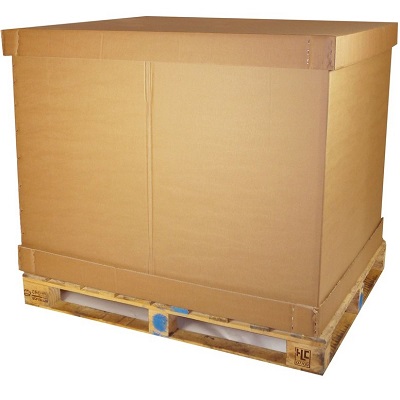
When they work well
A cardboard pallet box is a large corrugated container built to sit on a standard UK pallet, which measures 1,200 mm by 1,000 mm. Think of it as a very big carton with a pallet footprint. It suits seasonal stock such as gift sets, soft goods and flat-packed items, and it collapses flat afterwards, which frees up floor space in January.
Packaging suppliers can usually tell you the stacking limit for each box, so ask before you pile them three high. Lower boxes in a stack take all the weight, and corrugated board loses strength fast once it gets damp.
Sizing matters too. Pick a box your pallet can carry without overhang, because anything that sticks out gets clipped by doorframes and racking. If you ship by courier, check what pallet dimensions your carrier accepts before you buy a whole batch.
How do you move and wrap pallets safely?
Use a pump truck on a flat, hard floor to lift the pallet just clear of the ground, then secure the load with stretch film before it travels anywhere. Wrapping pallets takes a couple of minutes: start low, overlap each turn by about half and finish on the pallet base.
Choosing a pump truck
A pump truck is a manual pallet truck. You pump the handle to raise the forks a few centimetres, then pull the load along by hand. Many are rated at 2,500 kg, with forks around 1,150 mm long and 540 mm wide, which suits most single pallets. Wider forks give more sideways stability if your loads overhang.
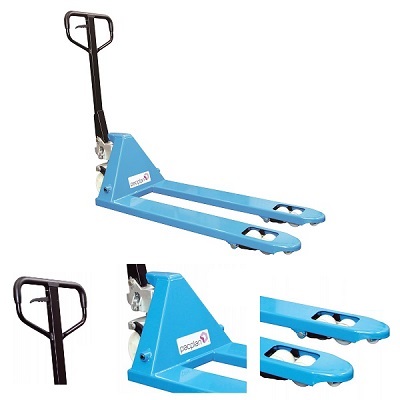
Common errors are simple to avoid. Push the forks fully under the pallet, never halfway. Keep loads within the rating. And don’t try to haul a loaded pallet up a ramp by hand. The small wheels want smooth concrete or similar, and they’ll struggle on gravel, cobbles and kerbs.
Wrapping pallets without the waste
Stretch film holds a load together and keeps dust and light rain off it. It isn’t a substitute for a sound stack, though. If boxes overhang the pallet edge, no amount of film will rescue them.
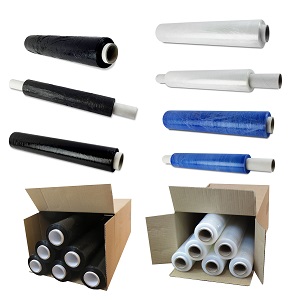
Here’s a simple routine for hand wrapping:
- Square up the boxes so they sit flush with the pallet edges.
- Anchor the film to the pallet base, then make two or three turns around the bottom, catching the pallet itself.
- Spiral upwards with each turn overlapping the last by about half the film’s width, keeping the tension steady.
- Add a few extra turns over the top layer to lock it in.
- Tuck the tail under a layer of film and press it flat.
FAQs
- How early should I order Christmas stock?
Aim for four weeks before your first big sales day, then top up weekly. Packaging suppliers become busy in late November, so delivery delays are more likely to occur later in the month. Ordering early also leaves room to swap anything that turns out to be the wrong size, without paying extra for speed.
- How much film does one pallet need?
It depends on load weight and shape, but a typical hand-wrapped pallet uses somewhere between five and ten turns up the stack plus extra at the base. Wrapping pallets with steady tension beats piling on layers. Heavy or uneven loads may need a thicker roll or a second pass.
- Can cardboard pallet boxes be reused?
Yes, if they stay dry and undamaged, and the base and walls aren’t crushed or torn. Most last a few trips. Check for soft corners, wet patches and bulging walls before loading again. If a box looks worn, treat it as single-use and recycle it rather than gamble with stock.
- Is one roll of tape enough for a Christmas rush?
Almost certainly not. As a rule of thumb, one standard roll seals 40 to 50 cartons using the H method. If you expect 500 parcels over the peak fortnight, that’s ten to twelve rolls before spares. Order a few extra rolls of tape, as it tends to be the first item to deplete.
Summing up
Good Christmas packing comes down to a handful of sensible decisions made early. Order your core stock four weeks before the first big sales day, but don’t blow the whole budget in one go. Match packaging materials to what you’re actually sending, test them before the rush and keep spares of the small things like tape and labels. For bulk stock, pick the right pallet container, wrap each pallet with even tension, and move loads on a flat floor. Get the dull details right now, and December takes care of itself.