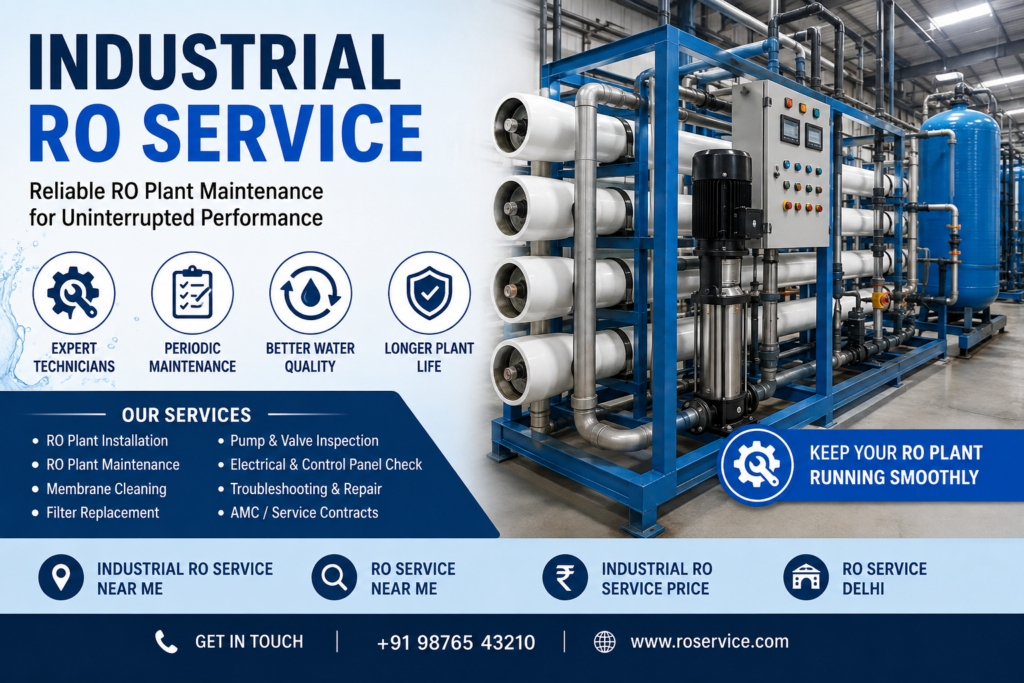

Industrial Reverse Osmosis (RO) plants play an important role in water treatment across manufacturing units, hotels, hospitals, food-processing facilities, commercial establishments, educational institutions, and many other industries. These systems are designed to reduce dissolved salts, unwanted minerals, suspended impurities, and other contaminants from feed water to produce purified water suitable for specific applications.
However, installing an industrial RO plant is only the beginning. To maintain consistent purification quality and reliable water production, the plant requires regular inspection, maintenance, cleaning, troubleshooting, and replacement of worn-out components. This is where professional industrial RO service becomes essential.
A properly maintained RO plant can operate more efficiently, experience fewer unexpected breakdowns, and provide more consistent output. On the other hand, delaying maintenance can lead to membrane fouling, pressure problems, reduced water flow, increased TDS, leakage, pump failures, and higher operating expenses.
Whether a business needs scheduled maintenance or urgent technical assistance, understanding the importance of industrial RO servicing can help in making better decisions about water-treatment operations.
What Is Industrial RO Service?
Industrial RO service is the professional maintenance, inspection, repair, cleaning, and performance assessment of an industrial Reverse Osmosis water purification system.
Unlike domestic RO purifiers, industrial RO plants contain multiple components that work together. Depending on the design and capacity, an industrial system can include:
- Raw water pumps
- Pressure sand filters
- Activated carbon filters
- Micron or cartridge filters
- High-pressure pumps
- RO membranes
- Membrane housings
- Flow meters
- Pressure gauges
- Dosing systems
- Control panels
- Solenoid and automatic valves
- Pipelines and fittings
- Storage tanks
- Electrical and automation components
Each part has a specific function. If one component develops a problem, it can influence the performance of the entire RO plant. Professional servicing focuses on identifying these issues and maintaining the system according to its operating requirements.
Why Is Industrial RO Service Important?
Industrial RO plants are often expected to operate for extended periods and process significant quantities of water. Continuous operation gradually affects consumable and mechanical components.
Regular service is important for several reasons.
Maintaining Consistent Water Quality
The main purpose of an RO plant is to produce treated water with the required quality. A decline in membrane performance, exhausted pretreatment filters, scaling, or incorrect operating conditions can affect the final water quality.
Routine monitoring allows technicians to identify changes in TDS, flow, pressure, and recovery before the problem becomes severe.
Improving Operating Efficiency
A well-maintained plant can operate more efficiently than a system affected by clogged filters, fouled membranes, or pump problems.
Maintenance helps ensure that water flows through the treatment stages properly and that components are operating within their intended conditions.
Reducing Unexpected Downtime
An industrial RO plant failure can interrupt production or other business activities. Emergency repairs can also be more expensive when multiple components are affected.
Preventive servicing helps identify potential failures early and gives businesses an opportunity to schedule repairs.
Protecting Expensive Components
RO membranes and high-pressure pumps are important investments. Improper pretreatment, scaling, fouling, and poor operating conditions can reduce their performance.
Regular service helps protect these components and supports longer operational life.
Common Signs That Your RO Plant Needs Service
Businesses should monitor their RO plant regularly rather than waiting for a complete shutdown.
Several warning signs can indicate that professional maintenance is required.
1. Reduced Purified Water Output
If the plant is producing less water than its normal capacity, there may be an issue with membrane fouling, pressure, cartridge filters, feed-water conditions, or the high-pressure pump.
2. Increase in Product Water TDS
An unexpected increase in TDS may indicate declining membrane rejection or another system problem. The cause should be diagnosed before replacing the membrane.
3. Increased Operating Pressure
A rise in pressure can be associated with membrane fouling, scaling, blocked filters, or other flow restrictions.
4. Unusual Pump Noise or Vibration
Abnormal noise or vibration from a pump should not be ignored. It can indicate mechanical or operational problems that may become more serious if the plant continues running without inspection.
5. Water Leakage
Leakage around membrane housings, valves, pipelines, fittings, or connections can result in water loss and may cause further damage if ignored.
6. Frequent Filter Replacement
If cartridge or pretreatment filters are getting blocked unusually quickly, the feed-water quality or pretreatment system may require evaluation.
7. Frequent System Shutdowns
Repeated shutdowns may indicate electrical, pressure, sensor, pump, or automation-related problems.
Major Components Covered During Industrial RO Service
Professional maintenance typically involves inspecting several sections of the plant.
Pretreatment System
Pretreatment is extremely important because it helps protect the RO membranes from suspended solids, chlorine, organic matter, hardness, and other contaminants.
Depending on the system, pretreatment may include sand filtration, activated carbon filtration, softening, dosing, and cartridge filtration.
Technicians can inspect pressure differences, filter condition, media performance, valves, and related components.
RO Membranes
Membranes are at the heart of the RO purification process. Over time, they can experience fouling or scaling.
During service, technicians may evaluate permeate flow, feed pressure, reject flow, TDS rejection, and other operating parameters. If cleaning is appropriate, membrane cleaning can be performed using a suitable procedure.
High-Pressure Pump
The high-pressure pump supplies the pressure needed for the RO process. Pump performance can affect both production and purification efficiency.
Inspection may include checking pressure, electrical connections, vibration, leakage, noise, and overall operating condition.
Cartridge Filters
Cartridge filters protect the RO membranes from fine particles that may pass through earlier filtration stages.
Blocked cartridges can increase pressure drop and affect plant performance. They should be inspected and replaced according to actual operating conditions.
Valves and Pipelines
Valves control water flow through different sections of the treatment system. Pipelines and fittings carry water between treatment stages.
During servicing, technicians can inspect these components for leakage, blockage, corrosion, or physical damage.
Electrical and Control System
Modern industrial RO plants may use automated controls, sensors, switches, timers, and electrical protection systems.
A service inspection can identify faulty sensors, loose electrical connections, damaged components, or control-panel problems.
Industrial RO Plant Preventive Maintenance
Preventive maintenance is generally more effective than waiting for an emergency breakdown.
A maintenance plan can include regular inspection of:
- Feed-water quality
- Product-water TDS
- Operating pressure
- Flow rate
- Membrane performance
- Cartridge filters
- Pretreatment filters
- Pump performance
- Chemical dosing
- Valves
- Pipelines
- Electrical controls
- Recovery rate
- Reject flow
The exact service frequency depends on the plant design, feed-water quality, operating hours, and application.
A plant processing challenging feed water may require more frequent attention than a system operating with effective pretreatment and relatively stable water conditions.
Industrial RO Service Near Me: What Should You Look For?
When businesses search for industrial RO service near me, proximity is useful, but it should not be the only selection factor.
The right service provider should ideally have experience with industrial water-treatment systems and understand the relationship between pretreatment, membrane performance, pumps, pressure, flow, and water quality.
Before choosing a service provider, consider:
Technical Experience
Industrial RO plants require a different level of technical knowledge compared with household water purifiers. Check whether the service team has experience with industrial-scale equipment.
Proper Diagnosis
A good technician should inspect the plant before recommending major repairs. The root cause should be identified rather than replacing components unnecessarily.
Spare Parts Availability
Availability of compatible membranes, filters, pumps, valves, gauges, fittings, and electrical components can reduce downtime.
Preventive Maintenance Plans
A service provider that offers scheduled maintenance can help businesses manage their RO plant more proactively.
Transparent Service Charges
Ask what is included in the service and whether replacement parts, cleaning, transportation, or additional labor are charged separately.
Understanding Industrial RO Service Price
The Industrial RO service price can vary considerably depending on the nature and scope of work.
There is no single service price applicable to every industrial RO plant because each system has different capacity, design, components, and maintenance requirements.
Factors that may influence the price include:
- Plant capacity
- Number of membranes
- Type of RO system
- Condition of membranes
- Required cleaning
- Filter replacement
- Pump servicing
- Electrical repairs
- Valve replacement
- Spare parts
- Emergency service requirements
- Location and travel
- Overall plant condition
A basic inspection may require considerably less work than a complete maintenance job involving membrane cleaning, pump repair, multiple filter replacements, and electrical troubleshooting.
Therefore, businesses should request a clear inspection and quotation before approving major work.
When Should You Call RO Service Near Me?
Searching for RO service near me can be useful when an industrial or commercial RO plant begins showing performance issues.
Professional assistance should be considered when there is:
- Low water production
- High product-water TDS
- Unusual pressure
- Membrane fouling
- Frequent leakage
- Pump noise
- Low recovery
- Frequent filter blockage
- Electrical faults
- Automatic shutdowns
- Poor purification performance
Quick attention can help prevent a relatively small issue from developing into a major plant failure.
Importance of RO Membrane Maintenance
RO membranes require special attention because their performance directly affects the quality and quantity of purified water.
Membrane fouling can occur because of suspended solids, organic matter, scaling substances, biological growth, or inadequate pretreatment.
Proper pretreatment and regular monitoring can help reduce the risk of severe membrane fouling.
When membrane performance declines, technicians can compare operating parameters with previous records to determine whether cleaning, adjustment, or replacement may be appropriate.
Maintaining records of pressure, flow, TDS, and recovery can make it easier to identify gradual performance changes.
RO Service Delhi for Industrial Requirements
Businesses located in Delhi and surrounding areas may specifically search for RO Service Delhi when they need professional assistance for their water-treatment systems.
Local service support can be particularly useful when quick technical assistance is required. However, businesses should still evaluate service quality rather than selecting a provider simply because they are nearby.
For industrial facilities in Delhi, a useful service arrangement may include routine preventive maintenance, emergency troubleshooting, spare-parts support, and periodic system performance checks.
Such an approach can help businesses manage their RO plants more efficiently and reduce the risk of unexpected interruptions.
Industries That Depend on Industrial RO Systems
Industrial RO systems are used in a wide variety of applications.
Manufacturing
Manufacturing facilities may require purified water for processing, cleaning, cooling, or other operational applications.
Food and Beverage
Food-processing and beverage facilities often have specific water-quality requirements. Reliable RO maintenance helps keep purification systems functioning consistently.
Hospitals
Healthcare facilities may use treated water for several operational purposes and can benefit from dependable water-treatment equipment and maintenance.
Hotels and Hospitality
Hotels and large hospitality facilities may require treated water for drinking, food preparation, housekeeping, and other applications.
Educational Institutions
Schools, colleges, hostels, and large campuses can use RO plants to provide treated water to students, staff, and visitors.
Commercial Facilities
Offices, restaurants, malls, and other commercial facilities may also depend on water purification systems for their daily requirements.
Benefits of Choosing Professional Industrial RO Service
Professional maintenance provides several practical benefits:
Better system monitoring: Regular inspection helps businesses understand the current condition of their RO plant.
Reduced downtime: Preventive maintenance can lower the risk of unexpected breakdowns.
Consistent performance: Properly maintained components can help the plant deliver more stable output.
Longer component life: Timely cleaning and servicing can reduce unnecessary stress on pumps, membranes, and other components.
Better maintenance planning: Scheduled servicing allows businesses to plan repairs and replacement of consumables.
Potential cost savings: Early detection of problems can help prevent more extensive repairs later.
How to Build an Effective RO Maintenance Schedule
A maintenance schedule should be based on the plant’s operating conditions rather than following a one-size-fits-all approach.
Daily or routine checks may include observing pressure, flow, TDS, leakage, and unusual sounds.
Periodic maintenance can include filter inspection, pump inspection, electrical checks, valve inspection, and membrane performance evaluation.
Detailed maintenance should also be documented. Keeping records of service dates, filter replacements, membrane cleaning, pressure readings, TDS values, and repairs can help technicians identify trends.
These records can also make future troubleshooting faster and more accurate.
Conclusion
A reliable industrial RO plant requires more than good-quality equipment. Regular maintenance and professional technical support are essential for maintaining water quality, production capacity, efficiency, and system reliability.
Professional industrial RO service can include membrane inspection, filter replacement, pump servicing, pressure and flow checks, electrical troubleshooting, pipeline inspection, valve maintenance, and overall plant performance evaluation.
Businesses searching for industrial RO service near me should consider technical experience, service response, spare-parts availability, preventive maintenance options, and transparent pricing before choosing a provider. The Industrial RO service price depends on the plant’s capacity, condition, required repairs, cleaning, replacement components, and other service requirements.
For businesses that need local support, RO Service Delhi can be a useful search term for finding technical assistance in the Delhi region. Similarly, RO service near me can help businesses locate nearby service options when immediate support is required.
Ultimately, preventive maintenance is one of the best ways to protect an industrial RO investment. By monitoring system performance, addressing warning signs early, and following a planned maintenance schedule, businesses can support reliable water treatment and reduce the likelihood of costly operational interruptions.