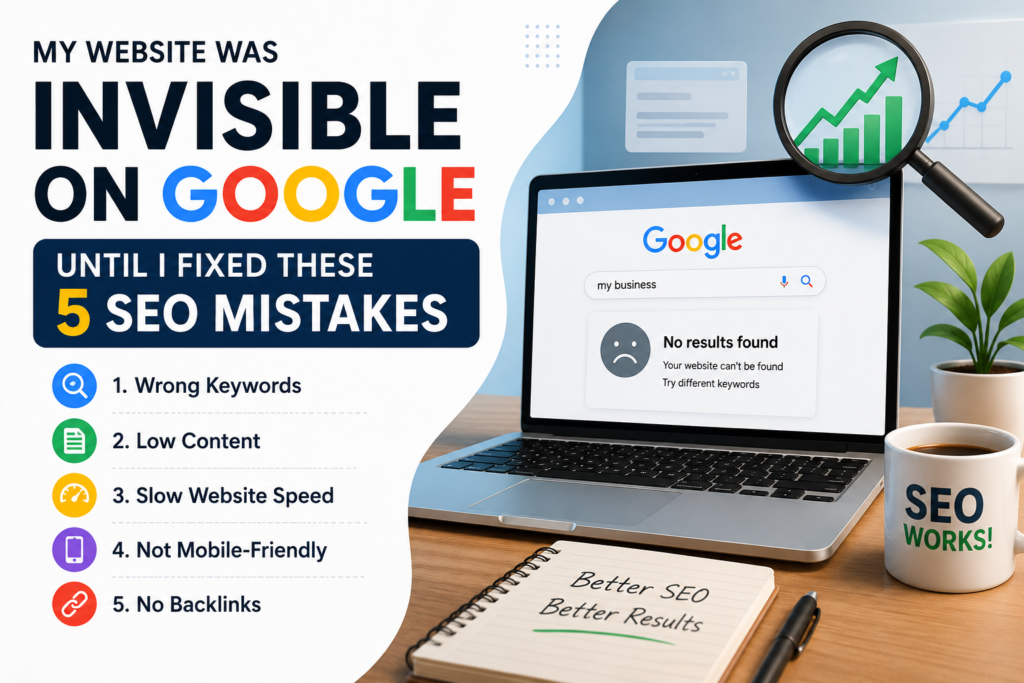

My Website Was Invisible on Google Until I Fixed These 5 SEO Mistakes
When I launched my website, I was excited.
The design looked professional, the pages were organized, and my services were clearly displayed. I believed customers would easily find my business through Google.
But that didn’t happen.
Weeks went by. Then months.
My website received very little traffic, and most visitors were people who already knew about my business. I started wondering:
“If my website is online, why can’t people find it on Google?”
That question led me to discover the importance of SEO (Search Engine Optimization).
A Good-Looking Website Isn’t Enough
At first, I thought the problem was the design.
Maybe I needed a new logo, different colors, or more attractive graphics.
However, I soon realized that search engines don’t rank websites based only on appearance. Google needs clear signals to understand what your website offers and why it should appear in search results.
My website looked good to visitors, but it wasn’t optimized for search engines.
Mistake #1: Targeting the Wrong Keywords
One of my biggest mistakes was using words and phrases that sounded professional but weren’t actually being searched by potential customers.
Instead of focusing on keywords such as:
- Freelance Digital Marketer
- SEO Services
- Website Development
- Social Media Marketing
I used complicated marketing terms with very low search volume.
After researching keywords and understanding search intent, I updated my website content using terms that real users were searching for. Within a few weeks, I noticed an increase in impressions through Google Search Console.
Mistake #2: Not Having Enough Content
Initially, my website only had a homepage and a contact page.
I assumed that was enough.
It wasn’t.
Google favors websites that provide useful and relevant information. To improve my visibility, I started publishing blog articles that answered common questions from my target audience.
Some topics included:
- What is SEO and why does it matter?
- Why every business needs a website
- Benefits of social media marketing
- Common digital marketing mistakes
Each article created another opportunity for my website to appear in search results.
Over time, organic traffic began to grow.
Mistake #3: Slow Website Speed
Website speed plays a major role in both user experience and SEO.
When I tested my website’s performance, I discovered that large images and unnecessary files were slowing it down.
To improve loading speed, I:
- Compressed images
- Removed unused plugins
- Optimized website files
- Improved overall performance
As a result, pages loaded faster, visitors stayed longer, and the website became more user-friendly.
Mistake #4: Ignoring Mobile Users
One day, I checked my website on a smartphone.
The experience wasn’t good.
Text appeared cramped, buttons were difficult to tap, and some images didn’t display correctly.
Since a large percentage of internet users browse on mobile devices, this was a serious issue.
After making the website responsive and mobile-friendly, user engagement improved significantly. Visitors could easily navigate the site regardless of the device they used.
Mistake #5: Having No Backlinks
Another major issue was the lack of backlinks.
Backlinks are links from other websites that point to your website. Search engines often view these links as signals of trust and authority.
To build backlinks, I started:
- Writing guest posts
- Creating business directory profiles
- Publishing useful content
- Participating in online communities
Gradually, other websites began linking to my content, helping improve my website’s credibility and visibility in search results.
The Results
SEO did not produce instant results.
It required consistency, patience, and continuous improvement.
But after applying these changes, I started seeing real progress.
My website began appearing in Google search results.
Traffic increased.
More people contacted me through my website.
And most importantly, some of those visitors became paying customers.
Key Lessons I Learned
SEO doesn’t have to be complicated.
If you focus on the fundamentals, you can significantly improve your website’s visibility.
Here are the five areas that made the biggest difference:
- Using relevant keywords
- Publishing valuable content
- Improving website speed
- Optimizing for mobile devices
- Building quality backlinks
Small improvements made consistently can lead to long-term growth.
Final Thoughts
Creating a website is only the first step.
Without SEO, even a beautiful website can remain invisible to potential customers.
If your website is struggling to attract visitors, don’t rush into a complete redesign. Start by improving the factors that help search engines understand and trust your website.
A few strategic SEO improvements can transform your website from an online brochure into a powerful tool for generating traffic, leads, and business growth.