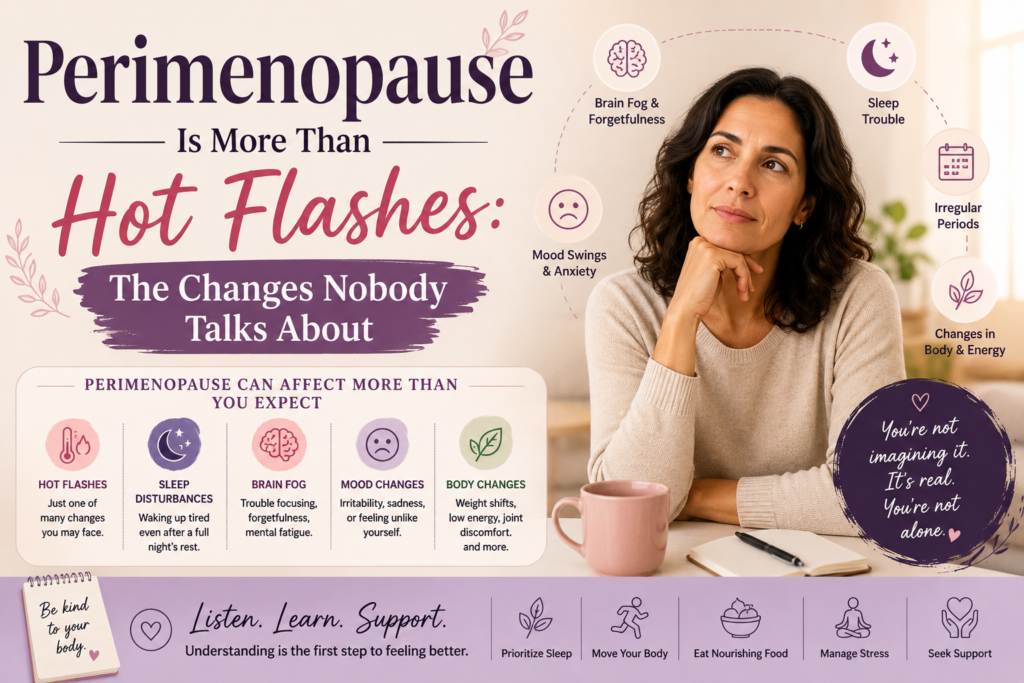

When people talk about perimenopause, hot flashes usually get all the attention.
You picture suddenly feeling too warm in the middle of a meeting. Throwing off the blankets at night. Opening a window when everyone else in the room is perfectly comfortable.
But for many women, the changes don’t stop there.
Sometimes, the things that feel most confusing are the ones nobody warned you about.
You may still get your period, but it behaves differently. You might sleep badly for no obvious reason. Your mood can feel unpredictable. You walk into a room and forget why you went there.
And then comes the question many women quietly ask themselves:
Is this normal, or is something else going on?
Your Period May Suddenly Have Its Own Plans
For years, your period may have been fairly predictable.
Then one month, it’s late.
The next, it’s early.
Maybe it’s heavier than usual. Maybe it’s lighter.
Maybe you skip a month and start wondering what’s happening.
During perimenopause, hormone levels can fluctuate, and periods often become less predictable. That unpredictability can be one of the first changes women notice.
Still, unusual or heavy bleeding shouldn’t simply be ignored. If something feels significantly different or worrying, it’s worth speaking with a healthcare professional.
Sleep Can Change Before You Realise Why
You go to bed exhausted.
But somehow, you’re awake at 3 a.m.
Not because of noise.
Not because you’ve had too much coffee.
You’re just awake.
For some women, night sweats can interrupt sleep. For others, sleep simply starts feeling lighter or more broken.
And after several nights like that, everything else becomes harder.
Your patience gets shorter.
Your concentration disappears.
Even simple tasks feel more tiring than they should.
A cooler bedroom, lighter bedding and a consistent sleep routine may help, but ongoing sleep problems are worth discussing with a healthcare professional.
The Mood Changes Can Be Hard to Explain
One minute, you’re fine.
The next, something tiny feels unbelievably irritating.
Or maybe you feel more emotional than usual and can’t quite explain why.
Hormonal changes can affect mood, but life during this stage can be busy too. Work, family responsibilities, poor sleep and stress don’t exactly disappear while your body is changing.
That’s why it can be difficult to separate one cause from another.
If anxiety, low mood or emotional changes are starting to affect your everyday life, don’t brush them off as something you simply have to tolerate.
Brain Fog Is a Real Frustration
You know that moment when you’re halfway through a sentence and completely forget what you were about to say?
Or you walk into the kitchen and stand there wondering why?
Everyone has moments like that.
But some women notice changes in concentration or memory during perimenopause, often described as “brain fog.”
It’s frustrating.
Especially when you’ve always been organised and suddenly feel like your brain has too many tabs open.
Poor sleep and stress can make concentration harder too, which is another reason looking at the whole picture matters.
Your Body May Feel Different
Perimenopause isn’t only about periods.
Some women notice changes in energy, headaches, joint discomfort, vaginal dryness or changes in sexual wellbeing.
Others notice very few symptoms.
There isn’t one standard experience.
That’s part of what makes this stage confusing. You can read ten different stories from ten different women and recognise something different in each one.
The Internet Has an Opinion About Everything
Search for perimenopause online and you’ll quickly find hundreds of suggestions.
Eat this.
Avoid that.
Take this supplement.
Follow this routine.
Buy this product.
It can become overwhelming.
Some women may choose to include perimenopause gummies as part of their wellness routine because gummies can feel convenient and easy to take.
But the front of the bottle shouldn’t be the only thing you look at.
Read the ingredients. Check the serving size. Think about what else you’re already taking.
And be careful with products that promise to fix every symptom at once.
The Menopause Conversation Is Changing
Thankfully, more women are talking openly about this stage of life than before.
That matters.
Because for a long time, many women experienced these changes without really knowing what was happening.
You may also come across menopause gummies while looking for products designed around this stage of life. If you’re considering a supplement, it’s worth asking what you actually want from it and whether its ingredients make sense for you.
A supplement can be one small part of a routine, but it isn’t a replacement for medical advice or a balanced diet.
Don’t Forget the Basics
When everything feels different, it’s tempting to search for one thing that will fix it all.
Usually, life isn’t that simple.
Start with the things you can realistically maintain.
Eat regular meals.
Move your body in a way you enjoy.
Protect your sleep when possible.
Take breaks when you need them.
Some women also explore a women health gummy as a convenient addition to their daily routine, but it should be a choice that fits your individual needs rather than something you take because the packaging makes big promises.
You Don’t Have to Pretend Everything Is Fine
Perimenopause is a natural stage of life.
But natural doesn’t mean easy.
And it definitely doesn’t mean you should quietly put up with symptoms that are affecting your work, relationships or everyday life.
Talk about what you’re experiencing.
Keep track of changes if that helps.
Ask questions.
Speak with a healthcare professional when something doesn’t feel right.
Because perimenopause is more than hot flashes.
Sometimes, the changes nobody talks about are the ones that make you feel the most alone—and knowing what’s happening can make the whole experience a little less confusing.