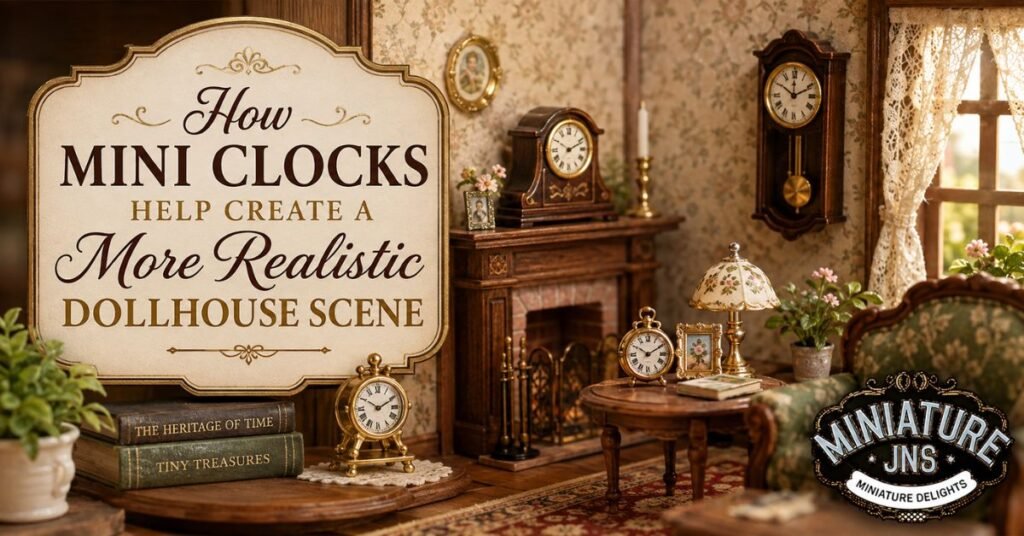

Of all the small objects a collector can add to a dollhouse, the clock may be the one that punches furthest above its weight. It is usually no more than an inch or two tall. It costs less than most furniture. And yet it does something no other accessory manages: it tells the viewer what time it is in the scene.
Miniature JNS carries clocks in a range of styles and periods, and this guide covers how to choose them, place them, and use them to make your scenes more convincing.
A Clock Anchors a Scene in Time
Miniature rooms are frozen. Nothing moves, nothing changes, and the viewer sees a single instant. The problem is that without a cue, that instant floats — the room could be any hour of any day.
A clock fixes it. Set the hands to 7:15 and a kitchen with a teapot and two cups becomes breakfast. Set them to 11:40 and the same kitchen becomes a late-night cup of tea. Nothing else in the room changed. The story did.
Once you have a time, other decisions follow naturally. Morning light means open curtains, breakfast things, a coat by the door. Evening means lamps on, curtains drawn, a fire lit, a book open in a chair. Collectors who set a clock early in the build often find the rest of the room comes together faster, because the time gives them a rule to design against.
Clocks also carry period information as strongly as any object in the house. A long-case grandfather clock says one era. A carriage clock under a glass dome says another. A round electric kitchen clock says the mid-twentieth century. A digital clock radio on a bedside table says something very recent indeed. Put the wrong clock in a room and it will jar even when the viewer cannot identify why.
Choosing the Right Clock for Each Room
Different rooms historically carried different clocks, and matching them correctly is one of the quiet details that separates a well-researched scene from a generic one.
The hallway and entrance belong to the tall case clock. A grandfather or longcase clock is a statement piece — it fills vertical space, draws the eye immediately on entry, and gives an otherwise narrow area something to be about. If your dollhouse has an entrance hall with nothing in it, a tall clock is often the single best fix.
The parlour or living room suits a mantel clock above the fireplace, or a shelf clock on a bookcase. This is the display position, so choose something with detail — a carved wooden case, a domed brass clock, an ornate face. It becomes the natural focal point of the mantel arrangement.
The kitchen wants something practical. A round wall clock, a plain-faced timepiece, or a schoolhouse-style clock hung where a cook could glance at it while working. Kitchen clocks were rarely decorative, and a plain one reads more honestly than a fancy one.
The bedroom takes a small alarm clock or a modest bedside timepiece. This is a lovely detail because it is so specific — an alarm clock on a nightstand implies a person who has to get up for something in the morning.
The study or office suits a desk clock or a small shelf clock near the work surface, sometimes paired with a barometer or a calendar. It reinforces the room’s sense of order and schedule.
You can browse styles across periods in the clocks collection and pick pieces that match the age of your house rather than defaulting to whatever looks prettiest on its own.
Placement and Height Make the Difference
A well-chosen clock in the wrong position still looks wrong, and height is where most people go astray.
Wall clocks in real rooms hang above head height — high enough to be seen from anywhere in the room, low enough not to disappear into the ceiling. In one-inch scale, that generally means around six to seven inches from the floor for a kitchen or hallway clock. A clock hung at eye level for a doll’s height is usually too low, and a clock tucked up near the cornice looks like an afterthought.
Mantel clocks sit centred on the shelf, which is exactly why they anchor a room so well. If you want a slightly less formal look, move it a little off centre and balance it with a candlestick or a small vase on the other side. Perfect symmetry looks like a showroom; near-symmetry looks like a home.
Think about sightlines. A clock positioned so it is visible from the front of the roombox or through an open doorway does far more work than one hidden behind a wing chair. In photographs especially, if the face cannot be read, half the clock’s value is lost.
Consider the wall behind it. A dark clock on dark panelling will vanish. A light clock face against pale wallpaper can wash out. A little contrast, or a small framed picture nearby for context, helps the clock read clearly. You can plan this alongside other wall pieces from the interior decorations range so the whole wall works as one arrangement.
The Time You Set Is a Creative Choice
Here is the detail most collectors never think about, and it is the most enjoyable part of using clocks: the hands can be set deliberately.
If your clock has moveable hands, choose the time on purpose. A dining room set for a meal reads best at around six or seven in the evening. A child’s bedroom with a lamp on reads well at half past eight. A kitchen with rising dough and an empty cup reads well at six in the morning. The hands become a caption for the scene.
Consistency matters if you can manage it. In a full dollhouse with several clocks, setting them all to roughly the same time makes the house feel like a single moment rather than several unrelated displays. If a clock in one room says three in the afternoon while another says midnight, an observant viewer will notice the contradiction.
You can also use a clock deliberately as a story device. A clock stopped at a particular moment in an abandoned or haunted house. A clock reading a few minutes fast on a busy hallway wall, because that household always ran late. A clock with the hands slightly crooked in a room that is otherwise neglected. These are small touches, but they are the kind of thing that makes visitors lean in and smile.
Layering Clocks With the Rest of the Room
A clock rarely works alone. It works as part of the arrangement around it.
On a mantel, pair a clock with candlesticks, a small vase, or a pair of figurines. The traditional garniture — clock in the centre, matching objects either side — is a genuinely period-correct arrangement and looks handsome in miniature.
Near a desk, group the clock with an inkwell, papers, and a lamp. In a kitchen, place it above a shelf of jars or beside a calendar. Grouping objects that share a purpose is how real rooms look, and it prevents your clock from looking as though it was dropped into an empty patch of wall.
Finally, remember that clocks are one of the few accessories that suit almost every room in the house. A hallway, a parlour, a kitchen, a bedroom, an office, a shop — each one takes a different style, and building a small collection across periods gives you flexibility for whatever you build next.
A mini clock is a tiny object that does an outsized job. It sets the period, fills the wall, anchors the mantel, and — most importantly — tells the viewer exactly what hour of somebody’s life they are looking at. Choose the right style, hang it at the right height, set the hands with intention, and a single inch of detail will make the whole room feel like it is genuinely happening.